Sustainability is no longer just a footnote in thermoforming: the European Thermoforming Conference 2026 showed an industry in transition
The European Thermoforming Conference 2026 in Strasbourg brought together material suppliers, manufacturers and equipment providers from across the thermoforming industry. While past events have focused almost exclusively on technical performance, sustainability and circularity dominated this year’s presentations and hallway conversations – with bio-based materials like Sulapac Flow 1.7 drawing particular interest.
1. A shift in mindset across the thermoforming industry
According to Commercial Growth Manager Joona Kontinen, who was among the keynote speakers at the event, the atmosphere felt noticeably different from previous years.
“A few years ago, the focus was strictly on performance. Now, the conversation is much more open and forward-looking. There’s less emphasis on defending the status quo and a genuine interest in finding better, future-proof solutions,” Kontinen points out.
What stood out was the range of approaches being explored: advances in rPET, new recycling technologies and more efficient ways to reduce material use and production scrap. “The question is no longer whether the industry can afford to change, but whether it can afford not to,” Kontinen notes.
2. New materials must work on existing thermoforming lines
Across discussions, one requirement kept coming up: sustainable thermoforming materials must work within existing production setups.
The bio-based and biodegradable Sulapac Flow 1.7 thermoforming material responds directly to this need. It runs on existing PET and PP thermoforming lines, allowing manufacturers to reduce reliance on conventional plastics without changing their processes.
“In addition to production practicalities, a common question I received was whether a biodegradable material would start to degrade on the shelf,” Kontinen shares. “In practice, it doesn’t. Biodegradation requires biological activity and moisture. In a retail or display environment, the material remains perfectly stable and durable for years.”
3. Sustainability needs to be seen and felt, not just measured
While much of the discussion in Strasbourg focused on the practical side of sustainable thermoforming, Kontinen reminded the audience that the shift to circularity isn’t just an engineering challenge – it’s a branding one.
“If a sustainable alternative is visually indistinguishable from traditional plastic, the brand loses a vital opportunity to communicate its values. The end-user doesn’t go and check the numbers in your sustainability report. They care about the experience,” Kontinen explains.
If nothing changes for the user except the price, the value of sustainability is easily lost.“To truly succeed, a material has to be meaningfully different. It needs to offer a premium, natural aesthetic and a tactile experience that tells the user, ‘this brand is making a conscious choice.’” Kontinen refers to this as the “business of feeling good”. In other words, sustainability should be both measurable and tangible.
4. Material choices in everyday thermoformed products can significantly reduce environmental impact
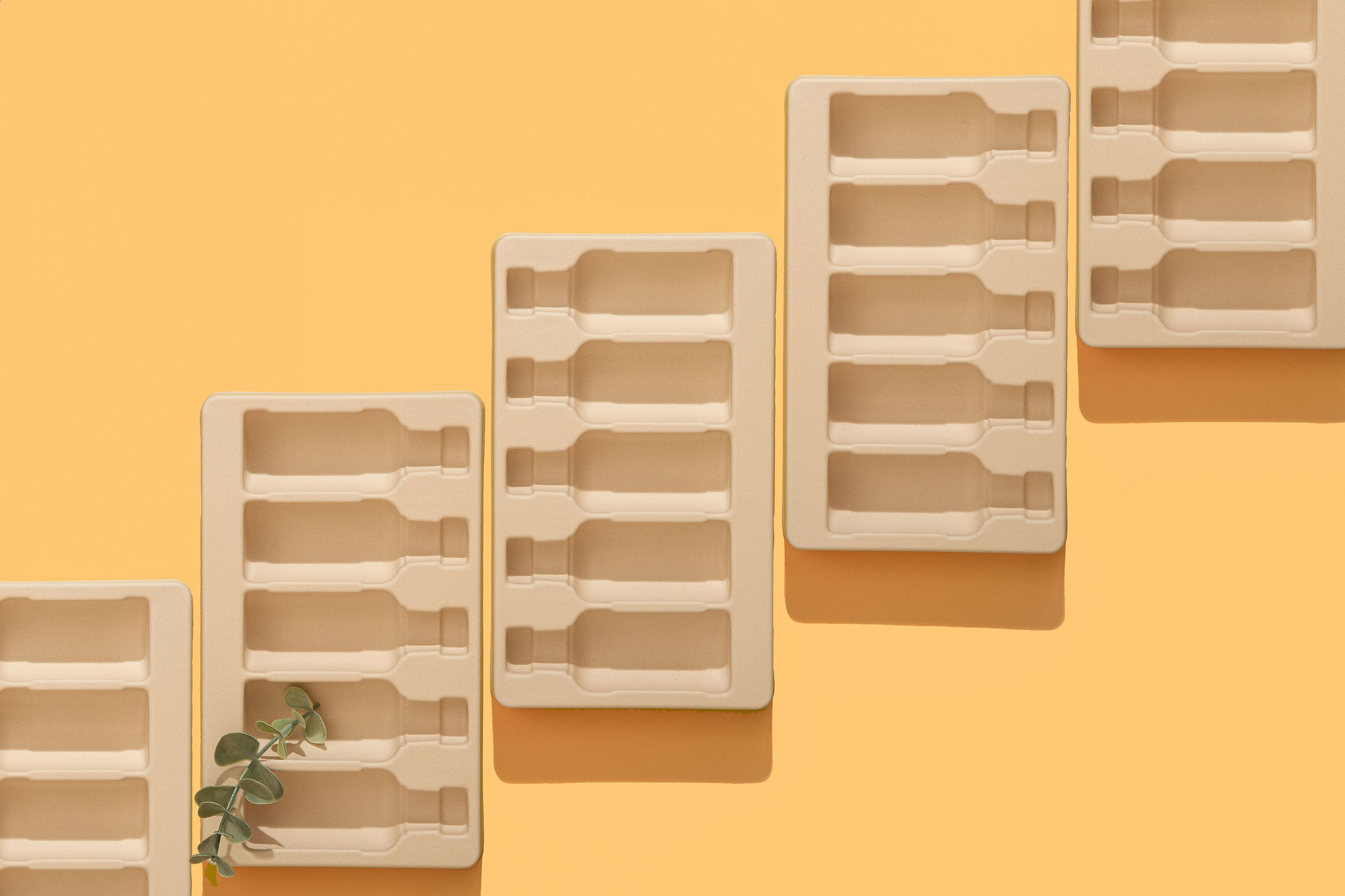
Much of the interest around Sulapac Flow 1.7 centred on everyday thermoformed products, such as packaging inserts, trays, and retail displays, where materials like PET and PP are widely used.
Because these components are produced in large volumes, switching their material can have a massive environmental impact, without requiring a redesign of the outer packaging. At the same time, these elements are among the first things the end user sees and touches. They are an important touchpoint for how sustainability is experienced in practice.
Interestingly, internal logistics also came up in discussions. Companies are increasingly looking at the footprint of their own operations, including the trays used to move components within factories. This opens up new use cases for materials like Sulapac Flow 1.7.
5. Fiber-based materials don’t always meet performance requirements
While fiber-based alternatives have gained traction, they require new equipment and can fall short in consistency and design flexibility. “We’re seeing cases where companies have tried fiber-based solutions and then returned to plastic-based materials, because they don’t always deliver the same consistency or performance,” Kontinen says.
“In electronics or luxury packaging, you need that ‘click-in’ functionality and elastic memory of plastic to hold products securely – something fiber struggles to replicate. Fiber can also release dust and particles, which is a major issue in premium products.”
The conversation often turns to PET as a recyclable alternative, but using PET doesn’t solve the environmental problem of microplastics. “One of the key advantages of Sulapac is that despite its plastic-like performance, it doesn’t leave behind permanent microplastics. This addresses a gap that traditional recycled plastic can’t solve,” Kontinen points out.
6. Regulation and regional differences are shaping adoption
Beyond technical factors, regulation and regional differences are shaping how the thermoforming market is evolving.
In Europe, regulatory development – particularly around the Packaging and Packaging Waste Regulation (PPWR) – has created both direction and hesitation. While sustainability targets are tightening, uncertainty around future details has in some cases slowed decision-making. Companies are waiting for clearer guidance before committing to new material choices.
However, the EU’s updated Bioeconomy Strategy, published in November, aims to scale the use of bio-based materials and support their wider adoption across industries. “The new strategy paves the way for a stronger role for bio-based materials and their wider adoption,” says Laura Tirkkonen-Rajasalo, Sulapac Co-founder and Chief Compliance Officer. “While the exact implementation is still evolving, it is clear that the EU wants to accelerate the adoption of bio-based solutions.”
The United States market, on the other hand, appears more fragmented but also more experimental. “While Europe often focuses on regulation and immediate costs, US companies are asking how much a material will cost in five years as they scale. They are more willing to adopt a startup mindset and move faster with new materials,” Kontinen says.
7. Collaboration across the thermoforming value chain enables real-world use
New materials only create value if they can be used in real production. This is why collaboration across the value chain is critical.
At the conference, Sulapac Flow 1.7 was showcased through Scanfill, which produces the thermoforming foil used in the process. “This kind of collaboration is essential for bringing new materials into the ecosystem. By combining Sulapac’s material innovation with our experience in foil extrusion, we can offer our customers a sustainable biobased plastic alternative that works in their existing processes.”
8. The focus is shifting from testing to implementation
The discussions in Strasbourg showed that the shift is already underway. The focus is no longer on whether more sustainable solutions are needed, but on how to make them work in practice – on existing lines, at scale. Both regulation and changing expectations from brands and consumers are driving this shift.
For most manufacturers, the challenge is now practical: how to integrate new materials into production, while keeping business as usual.
If you’re exploring sustainable thermoforming solutions, get in touch with our team to discuss how Sulapac Flow 1.7 could work on your existing production lines.
 07.08.2026
  3 min
3 min